High-Performance Pigments for Engineering Plastics: Complete Guide
Industry Requirements
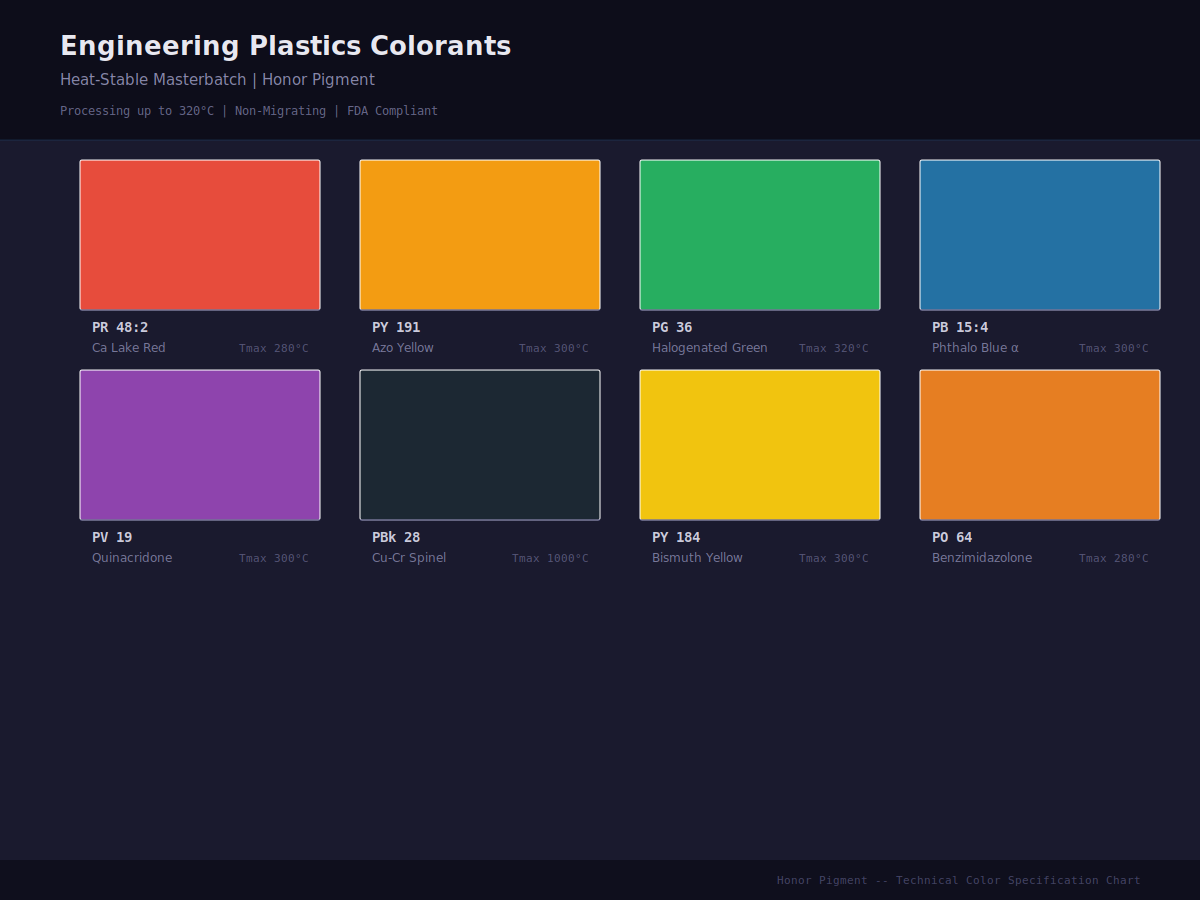
Engineering plastics used in electronics, automotive, and industrial applications require pigments that maintain performance under extreme conditions while providing consistent coloration. From German automotive OEM specifications to Japanese electronics manufacturing standards and Korean injection molding operations, the demand for heat-stable, non-migrating pigments spans global supply chains. Our Pigment Yellow 191 for plastics offers excellent heat stability for these demanding applications. For transparent engineering polymers like PS, ABS, and PC, Solvent Yellow 114 delivers high clarity with strong heat resistance, while Solvent Red 135 provides the same benefits for transparent red applications in Southeast Asian electronics manufacturing and beyond.
Key Performance Criteria
- Heat stability during processing (280-320°C)
- Resistance to hydrolysis and oxidation
- Non-migrating properties
- Electrical insulation compatibility
- Regulatory compliance (FDA, EU food contact)
Products such as Pigment Yellow 13 for plastics deliver reliable non-migrating performance across these criteria. For opaque orange applications, Pigment Orange 34 (HP Orange 3646) offers best-practice guidance for engineering polymers requiring high opacity and heat stability.
Technical Innovation
Our high-temperature stable pigments feature:
- Surface-modified crystal structures
- Optimized particle size distribution (0.1-0.5μm)
- Enhanced compatibility with engineering polymers
- Low heavy metal content (<5ppm)
Pigment Yellow 14 for plastics exemplifies these innovations with its optimized particle size distribution and enhanced polymer compatibility. Pigment Red 53:1 (HP Red 2537) applies similar engineering to red-shade plastics formulations.
Application Benefits
Successful implementation in electronic housings demonstrated:
- No degradation during injection molding cycles
- Consistent L*a*b* values across production runs
- Improved mechanical properties retention
- Reduced scrap rates by 12%
Global Market Relevance
Engineering plastics pigmentation is a global discipline. Brazil’s growing automotive and industrial plastics sector increasingly demands pigments that can withstand tropical humidity without hydrolytic degradation. Southeast Asian electronics manufacturing hubs — from Thailand to Vietnam — require batch-consistent color for high-volume production lines. German coatings and plastics OEMs enforce some of the strictest heat-stability and migration-resistance specifications in the industry, while Japanese and Korean manufacturers prioritize precision shade control measured in ΔE tolerances below 1.0. Our pigment portfolio is tested against these diverse regional requirements to ensure consistent performance wherever your production line runs.
Future Developments
Ongoing research focuses on bio-based carrier systems and improved recyclability without compromising performance.
Need high-performance pigments for your engineering plastics? Contact Honor Pigment for technical data sheets (TDS/SDS) and free samples. Get in touch →
Disclaimer: This article is for general reference only. Always verify specifications with our team and review the current full legal disclaimer, TDS and SDS before product use.