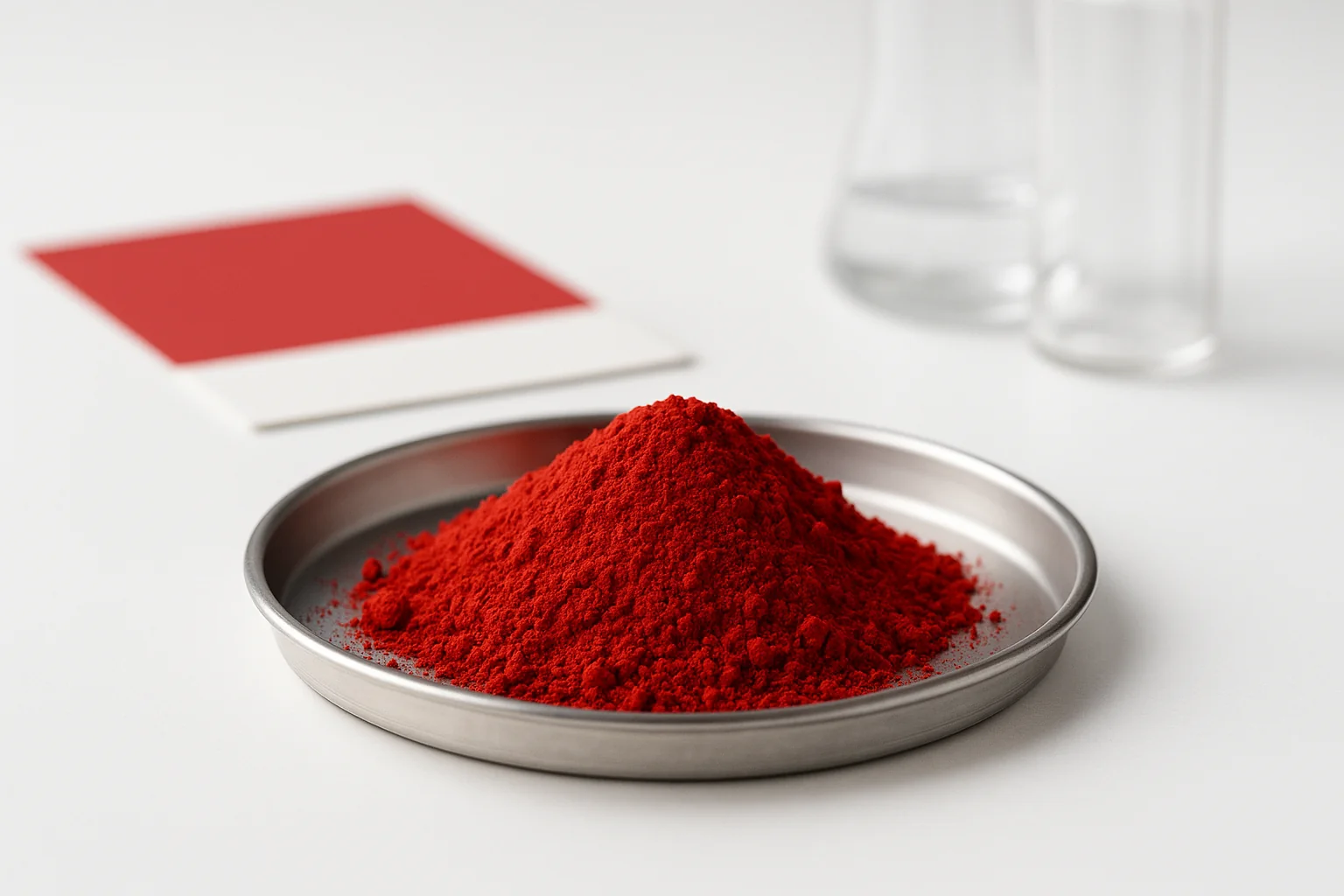
PR170 Buyer Guide: Qualifying Pigment Red 170 for Industrial Applications
Choosing a red pigment grade for production isn’t only about shade. For most industrial teams, the real risk sits in qualification time, batch consistency, migration/bleed behavior, and whether the supplier can support audits with the right documentation.
This guide lays out a procurement-ready framework for evaluating C.I. Pigment Red 170 (PR170) for coatings, plastics & masterbatch, and printing/packaging inks—with a clear checklist you can use to qualify a specific grade such as Pigment Red 170F5RK / HP Red 2131.
1) Pigment Red 170 (PR170): confirm identity and documentation first
Before you compare performance, lock down “what exactly are we buying?” This prevents avoidable re-qualification later.
If you’re migrating from a branded grade such as Clariant F3RK70, review our PR170 F3RK70 equivalent alternatives before building your test plan.
Confirm these items up front:
-
Color Index (CI) name: C.I. Pigment Red 170 (PR170).
-
CAS number: confirm via the supplier’s SDS/TDS (don’t rely on email descriptions or informal spec sheets).
-
Regulatory documentation set: at minimum, SDS and TDS for the exact grade you’re qualifying.
-
COA expectations: define what must appear on each batch Certificate of Analysis (COA) (test items, methods, limits, and traceability).
⚠️ Warning: If a supplier can’t provide an SDS/TDS/COA package for the exact grade name you’re ordering, treat that as a qualification risk—especially when you operate change-control or approved vendor lists.
2) Define pass/fail requirements by end use
PR170 can be used across multiple applications, but qualification criteria shift depending on resin system, processing temperature, and exposure conditions. Define your “done means done” requirements in your internal test plan.
Coatings (industrial, automotive, powder)
For coatings, teams typically qualify PR170 around three themes: appearance, durability, and process robustness.
Focus areas to include in your evaluation:
-
Tinting strength / color development: confirm the shade target and strength relative to your internal standard.
-
Dispersion behavior: evaluate how quickly you reach a stable grind and whether viscosity rises unexpectedly.
-
Lightfastness and weathering: align the test condition to your end use (interior vs exterior; UV exposure expectations).
-
Solvent and chemical resistance: check resistance against the solvents/chemicals your coating actually sees.
-
Heat stability: confirm the pigment holds shade and strength through your bake/process window.
Plastics and masterbatch
For plastics, PR170 qualification often fails (or passes) on processing heat, migration/bleed, and batch-to-batch stability.
Focus areas to include in your evaluation:
-
Heat resistance during processing: confirm the pigment tolerates your real melt temperature and residence time.
-
Migration / bleed resistance: test against the substrates and additives you actually use (plasticizers, slip agents, contact layers).
-
Dispersion in your carrier: check whether you need special dispersants or higher energy input to hit your QC targets.
-
Color consistency: confirm that batch variation stays inside your ΔE tolerance and does not force frequent formulation correction.
Printing and packaging inks
Printing inks add another layer: rheology, solvent exposure, and rub/transfer performance.
Focus areas to include in your evaluation:
-
Dispersion and viscosity stability: confirm stable ink viscosity and no unexpected thickening over time.
-
Solvent resistance: verify resistance relative to your solvent system and end-use contact scenario.
-
Lightfastness and weathering: define exposure expectations (e.g., outdoor labels vs indoor packaging).
-
Low migration / bleed: especially important when inks contact overprint varnishes, laminations, or sensitive substrates.
3) Qualification workflow you can run (sample to production)
A clean qualification process reduces risk and keeps procurement and technical teams aligned.
Step 1 — Request a sample package that matches real production
Ask for samples that represent the grade you plan to buy (same treatment, same particle characteristics), plus the documentation set.
Minimum request package:
-
A sample of the grade
-
TDS (Technical Data Sheet)
-
SDS (Safety Data Sheet)
-
A COA example (what you will receive with each batch)
Step 2 — Run lab-scale tests aligned to your failure modes
Don’t test “everything.” Test the things that cause scrap, rework, customer complaints, or regulatory friction.
A practical test approach:
-
Define your internal pass/fail criteria (shade, strength, dispersion time, migration/bleed behavior, durability)
-
Use your own resin system, processing window, and substrate
-
Document your procedure so results are reproducible and auditable
Step 3 — Pilot / scale-up under real processing conditions
Many pigments look fine in lab drawdowns but drift at scale.
In pilot runs, watch for:
-
Shade shift after full thermal history
-
Dispersion variability run-to-run
-
Processing stability (filterability, viscosity, foaming issues where relevant)
Step 4 — Lock change-control rules before you approve the supplier
If you work with approved vendor lists, build these items into supplier approval:
-
COA requirements (tests included, frequency, traceability)
-
Definition of “material change” (raw materials, process, site, treatment)
-
Notification expectations and re-qualification triggers
4) Red flags and deal-breakers for procurement and QC
These issues commonly cause late-stage delays:
-
No clear documentation trail: SDS/TDS/COA missing, inconsistent, or not grade-specific.
-
Unclear batch traceability: COA cannot be tied to lot numbers and shipment documents.
-
Vague fastness claims: performance statements without context (test condition, method, or internal standard).
-
Unmanaged variation: frequent shade/strength drift that forces ongoing correction in production.
-
Logistics uncertainty: unclear packaging, inconsistent lead times, or weak communication during shipping disruptions.
Pro Tip: Treat “data turnaround time” as a supplier KPI. Slow response on COA clarifications or test questions is usually a preview of slow response during a real quality event.
5) What to request from the supplier (so your approval doesn’t stall)
For decision-stage evaluation, buyers usually need more than a brochure. Ask for a package that helps you qualify and re-order reliably.
Documentation
-
TDS: key properties and recommended applications for the exact grade
-
SDS: safety and handling information
-
COA: batch-specific results and traceability
Quality & supply information
-
Batch identification and traceability approach
-
Packaging options and storage recommendations
-
Typical lead time and shipping terms
-
Support process for technical questions during trials
If you’re evaluating Pigment Red 170F5RK / HP Red 2131, you can start the conversation with Honor Pigments and request the sample + document set above.
Next steps: request samples and the qualification packet
If you’re preparing to qualify PR170 for coatings, plastics/masterbatch, or printing inks, the fastest way to reduce risk is to evaluate the grade with the right documents and a test plan that matches your real process.
Request:
-
PR170 sample (HP Red 2131)
-
TDS + SDS
-
COA example + batch traceability details
-
Pricing, MOQ, and lead time
Contact us for TDS/SDS and sample coordination.
FAQ
Is PR170 the same as “Pigment Red 170F5RK”?
PR170 is the Color Index category, while a grade name like “170F5RK” typically reflects a specific manufacturer’s treatment and performance balance. Always qualify the exact grade using its SDS/TDS and your application test plan.
Can I approve PR170 based on a lab drawdown only?
A drawdown is a good start, but most production issues show up during thermal history, scale-up dispersion, and migration/bleed checks under real substrate and additive conditions.
What documents should be non-negotiable for supplier approval?
For most procurement workflows: SDS, TDS, and COA for the exact grade, plus clarity on lot traceability and material-change notification expectations.
Looking for Pigment Red 170? Contact Honor Pigment for technical data sheets (TDS/SDS) and free samples. Get in touch →
Disclaimer: This article is for general reference only. Always verify specifications with our team and review the current full legal disclaimer, TDS and SDS before product use.